Traditional Rice Mills in Vietnam – Discover an Important Tool of Vietnamese Agricultural Culture
Rice has always been at the heart of Vietnamese life. From the green rice fields surrounding rural villages to the steaming bowls of noodles served in family kitchens, rice is much more than a staple food—it is deeply connected with agriculture, traditions, and everyday life.
When visiting Hoi An, travelers can discover this connection through the traditional food and farming experiences of Quang Nam. Many local dishes are based on rice or rice flour, including crispy Hoi An banh xeo and flavorful Quang noodles.
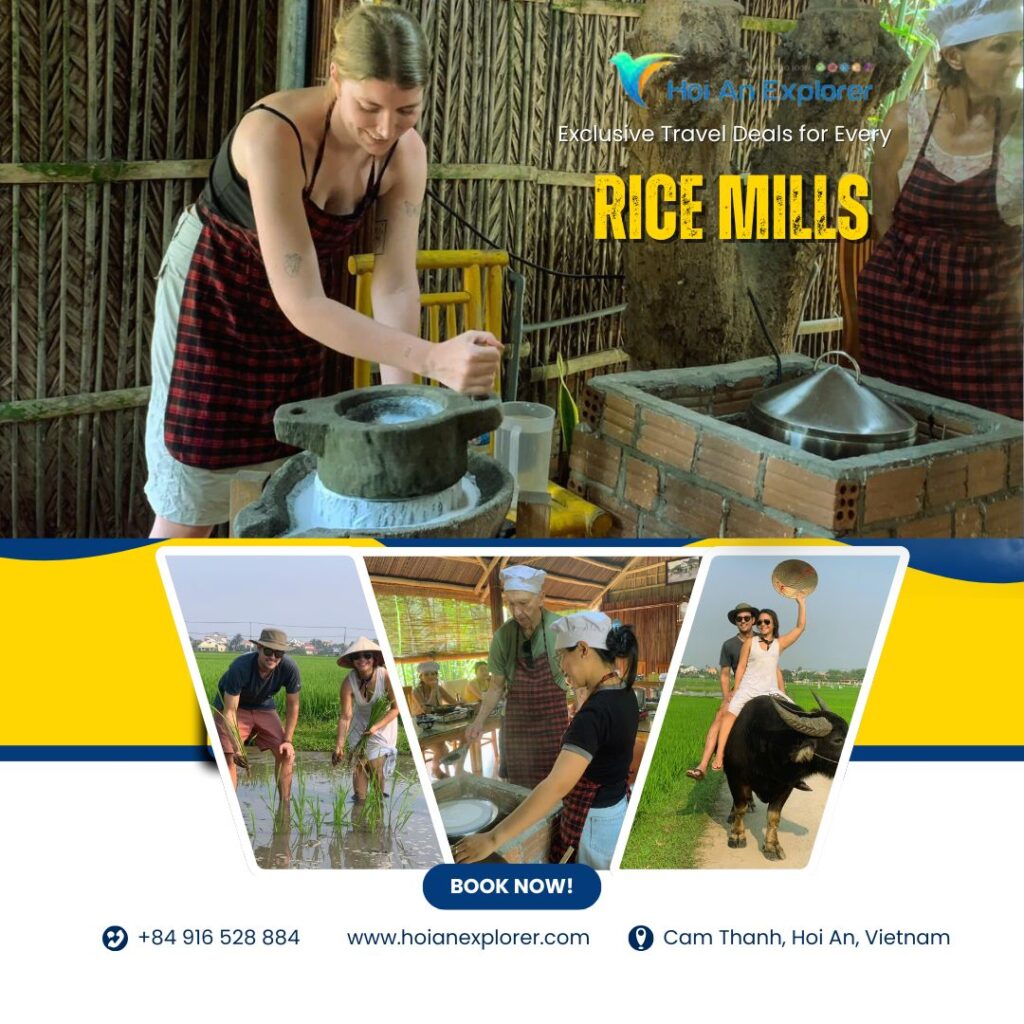
Behind these familiar dishes is a traditional process that was once part of everyday household life: turning rice grains into flour with simple tools such as a stone mortar and traditional rice mill.
For any further information about Hoi An Explorer, please get in touch with the hotline at 0905.223.343 (Ms Tina)
See more details >>> Wet Rice Growing – Riding Buffalo And Plowing Farm At Cam Thanh
Rice and the Story of Vietnamese Agricultural Life
For centuries, rice cultivation has shaped the landscape and lifestyle of Vietnam. In central Vietnam, farmers have traditionally depended on seasonal cycles, water, fertile fields, and considerable manual work to grow and process rice.
Before modern food-processing equipment became widely available, families relied on simple agricultural tools to prepare rice for cooking and flour production. These tools were practical, durable, and often passed from one generation to another.
The traditional rice mill or mortar therefore represents more than a method of processing grain. It is a reminder of the close relationship between Vietnamese communities and the land that supported them.
What Is a Traditional Rice Mill?
A traditional rice mill is a simple tool used to process rice or other grains through manual grinding or pounding. Depending on the region and purpose, Vietnamese households historically used different forms of stone and wooden equipment.
For flour-based dishes, rice would be processed until it reached the desired texture. The resulting flour could then become an ingredient for pancakes, noodles, cakes, porridge, and many other traditional foods.
Today, machines perform these tasks much faster, but traditional grinding methods remain valuable as a cultural demonstration and as a way to understand how Vietnamese food was prepared before modern technology.
The History and Role of Rice Mills in Vietnam
Traditional rice-processing tools developed alongside Vietnam’s agricultural communities. As wet-rice cultivation became an essential part of life, people needed practical ways to clean, pound, grind, and prepare rice for consumption.
The process was once a familiar part of household work. Rice was not simply purchased as a finished ingredient. Families were involved in transforming harvested grain into food, making the connection between the rice field and the kitchen much more visible than it is today.
Rice flour could be used to prepare a wide range of traditional foods, including steamed cakes, rice noodles, pancakes, and other regional specialties. This helped make rice-processing tools an important part of everyday Vietnamese culinary culture.
Traditional Stone Mills and Mortars
Among the oldest and most recognizable tools are stone mills and mortars. Their simple construction made them useful for grinding grains and other ingredients.
Stone Mills
Traditional stone mills are generally heavy and sturdy. Their weight and hard surfaces allow grains to be crushed and ground through repeated movement.
Although using a stone mill requires considerably more effort than using modern electrical equipment, the process provides an interesting insight into traditional food preparation. Visitors participating in a cultural experience can see how much patience and physical work were once required to produce something as basic as rice flour.
Wooden Mortars
Wooden mortars were also common household tools. They were made from durable hardwood and could be used for pounding rice and other grains.
Compared with large stone equipment, wooden tools could be more practical for household use. Their presence in rural kitchens and traditional food preparation reflects the resourcefulness of Vietnamese communities.
From Manual Grinding to Modern Rice Mills
Vietnamese agriculture and food production have changed significantly with the development of modern machinery. Industrial mills can now process large quantities of rice and flour in a fraction of the time required by traditional methods.
Modern technology has made food production more efficient and helped meet the needs of growing communities. As a result, manual rice grinding is no longer an everyday necessity for most Vietnamese households.
However, traditional tools have not completely disappeared. They can still be found in some rural communities, cultural demonstrations, traditional food-making activities, and special celebrations.
Their role has gradually changed from an essential household tool to an important reminder of Vietnam’s agricultural heritage.
Rice Mills and Vietnamese Culinary Culture
The importance of rice-processing tools becomes easier to understand when you look at Vietnam’s food culture. Rice is transformed into many different forms, from whole grains to noodles, flour, cakes, wrappers, and fermented products.
In Quang Nam, this connection is particularly interesting because many famous local dishes rely on rice-based ingredients. During a Hoi An cooking class, visitors can discover how basic local ingredients are transformed into familiar dishes through traditional techniques.
For travelers, seeing or using a traditional rice mill adds another layer to the cooking experience. Instead of simply learning a recipe, you begin to understand where the ingredients come from and how Vietnamese families prepared food in earlier generations.
Rice-Based Dishes You Can Discover in Hoi An
Hoi An and Quang Nam have a rich culinary tradition built around fresh local ingredients and long-established cooking methods. Several popular dishes have a close relationship with rice.
Banh Xeo
Banh xeo is a crispy Vietnamese rice-flour pancake typically prepared with a savory filling and served with fresh herbs and dipping sauce. In Hoi An, learning to make banh xeo is a popular activity for visitors interested in Vietnamese cuisine.
Quang Noodles
Mi Quang is one of Quang Nam’s signature dishes. Its distinctive noodles are made from rice and are served with a relatively small amount of flavorful broth, fresh herbs, vegetables, and a variety of toppings.
These dishes demonstrate how Vietnamese cooks have transformed a simple agricultural product into food with distinctive regional identity.
Experience Traditional Rice Processing During a Hoi An Cooking Class
A Hoi An cooking class is a great way to explore the relationship between rice, farming, and Vietnamese cuisine.
Depending on the experience, travelers can learn about local ingredients, observe traditional preparation methods, and take part in making familiar Vietnamese dishes. Activities involving rice flour provide a practical connection between the raw grain and the food eventually served on the table.
This is particularly enjoyable for visitors who want something beyond a standard sightseeing tour. You are not only watching a demonstration—you are learning through your hands, your senses, and the stories shared by local hosts.
Discover the Journey from Rice Field to Kitchen
If you want to understand traditional rice culture more deeply, consider combining a cooking experience with a countryside farming activity.
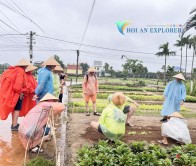
The Wet Rice Growing and Buffalo Riding Tour in Hoi An introduces visitors to the agricultural side of local life. Depending on the program, travelers can discover traditional farming activities and experience the countryside around Cam Thanh.
Connecting the rice field with the kitchen makes the story much clearer: rice begins as a crop cultivated by farmers and eventually becomes an essential ingredient in the dishes enjoyed at the family table.
Why Traditional Rice Mills Still Matter Today
It might seem surprising that such a simple tool can hold cultural importance in a modern country. Yet traditional agricultural equipment helps preserve a physical connection with the past.
A rice mill tells the story of manual labor, farming knowledge, family cooperation, and culinary traditions. It reminds younger generations and visitors alike that many foods now considered everyday dishes once required considerably more time and effort to prepare.
Traditional tools can therefore serve as educational objects. They help explain the development of Vietnamese agriculture while giving travelers a more tangible understanding of rural life.
The Rice Mill as a Symbol of Vietnamese Farmers
Beyond its practical function, the traditional rice mill can be viewed as a symbol of the hardworking nature of Vietnamese agricultural communities.
Growing rice requires patience. Farmers must work with seasons, water, weather, soil, and the natural rhythm of the fields. Processing the harvested grain traditionally required another significant amount of physical effort.
The humble rice mill represents this connection between labor and food. Every bowl of rice or rice-based dish carries a much longer story than what appears on the dining table.
Traditional Rice Mills in Hoi An Cultural Experiences
For visitors exploring Hoi An, traditional agricultural tools can make cultural activities more meaningful. Rather than seeing rice only as an ingredient in a cooking class, travelers can learn how it fits into the wider history of rural Vietnam.
This is one reason hands-on experiences have become an appealing part of Hoi An tourism. Cooking, farming, fishing, and traditional crafts allow visitors to interact with local culture rather than simply observe it.
A traditional rice mill may look simple, but it opens the door to a much bigger story about Vietnamese food, farming, family life, and cultural identity.
Traditional Rice Mill vs. Modern Rice Mill
| Traditional Rice Mill | Modern Rice Mill |
|---|---|
| Usually operated manually | Powered by modern machinery |
| Designed for household or small-scale use | Designed for large-scale production |
| Requires considerable time and physical effort | Processes rice much more quickly |
| Strong connection with traditional rural life | Focused on efficiency and production |
| Often preserved for cultural and educational purposes | Widely used in contemporary food processing |
See More Details >>> Wet Rice Growing and Buffalo Riding in Cam Thanh
Want to discover where Vietnamese rice comes from before learning how it becomes food? The Wet Rice Growing – Riding Buffalo and Plowing Farm at Cam Thanh experience offers a different perspective on the agricultural traditions surrounding Hoi An.
Combined with a Hoi An cooking class, it creates a fascinating journey from farm to table. You can discover the work involved in growing rice and then see how local ingredients are transformed into traditional Vietnamese dishes.
Discover the Traditional Tools Behind Vietnamese Food
The traditional rice mill may no longer be an essential tool in most modern Vietnamese kitchens, but its cultural value remains. It represents a time when rice processing was closely connected to household life and agricultural work.
For visitors to Hoi An, discovering this humble tool can make a cooking experience much more meaningful. Behind every plate of rice noodles, crispy banh xeo, or traditional rice-based dish is a story of farmers, fields, ingredients, and generations of culinary knowledge.
So when you join a Hoi An cooking class or explore the rice fields of Cam Thanh, take a moment to look beyond the finished dish. The traditional rice mill is a small but fascinating part of the much larger story of Vietnamese agricultural culture—a story that continues to shape the food and traditions of Hoi An today.
YOU MAY LIKE IT
Guide to local REAL Hoi An Cooking Class on Wooden Boat – A Unique Distinctive Experience Culinary Journey
Unveiling the Magic of a Hoi An Cooking Class on Boat: A Must-Try Culinary Adventure. While traditional culinary workshops nestled inside cozy ancient houses offer a wonderful glimpse into...